

Welcome back to Comms Care, our monthly guidance for healthy communications.

Developing a brand tone, one that captures the spirit of the brand, is recognisable, and builds a community with the brand’s consumers, is an exercise that can cost organisations thousands of pounds.
Or it can be defined by one savvy comms person.
I met with Joe Vaughan, Marketing Manager at The Museum of English Rural Life (The MERL) to find out how this delightfully niche organisation went viral thanks to its tongue-in-cheek brand voice.
When did The MERL first launch its social media presence? Which platforms did you choose and why?
The MERL social media first emerged in the early 2010s. We set up pages on Facebook, Twitter, and Tumblr, as they were the most popular platforms at the time. How things have changed!
How did you develop your tone of voice for The MERL on those social media platforms?
To begin with, we understood that the highest value opportunity of social media was for communicating with audiences. Not just broadcasting to them, but listening to them and speaking in kind.
So, we chose a tone that was relaxed, friendly, and welcoming. We prioritised language that would be easy to understand and matched the spaces we were in. This felt especially important because we’re a university museum that deals with quite complex and technical history. We had to put in the work to make our content understandable, relatable, and relevant.
Over time, the pursuit of relevance led our tone of voice to evolve, as we prioritised what meant the most to our audience.
Tell me about your viral moment. How did it happen? What do you think captured the imagination of the audience at that point in time so effectively?
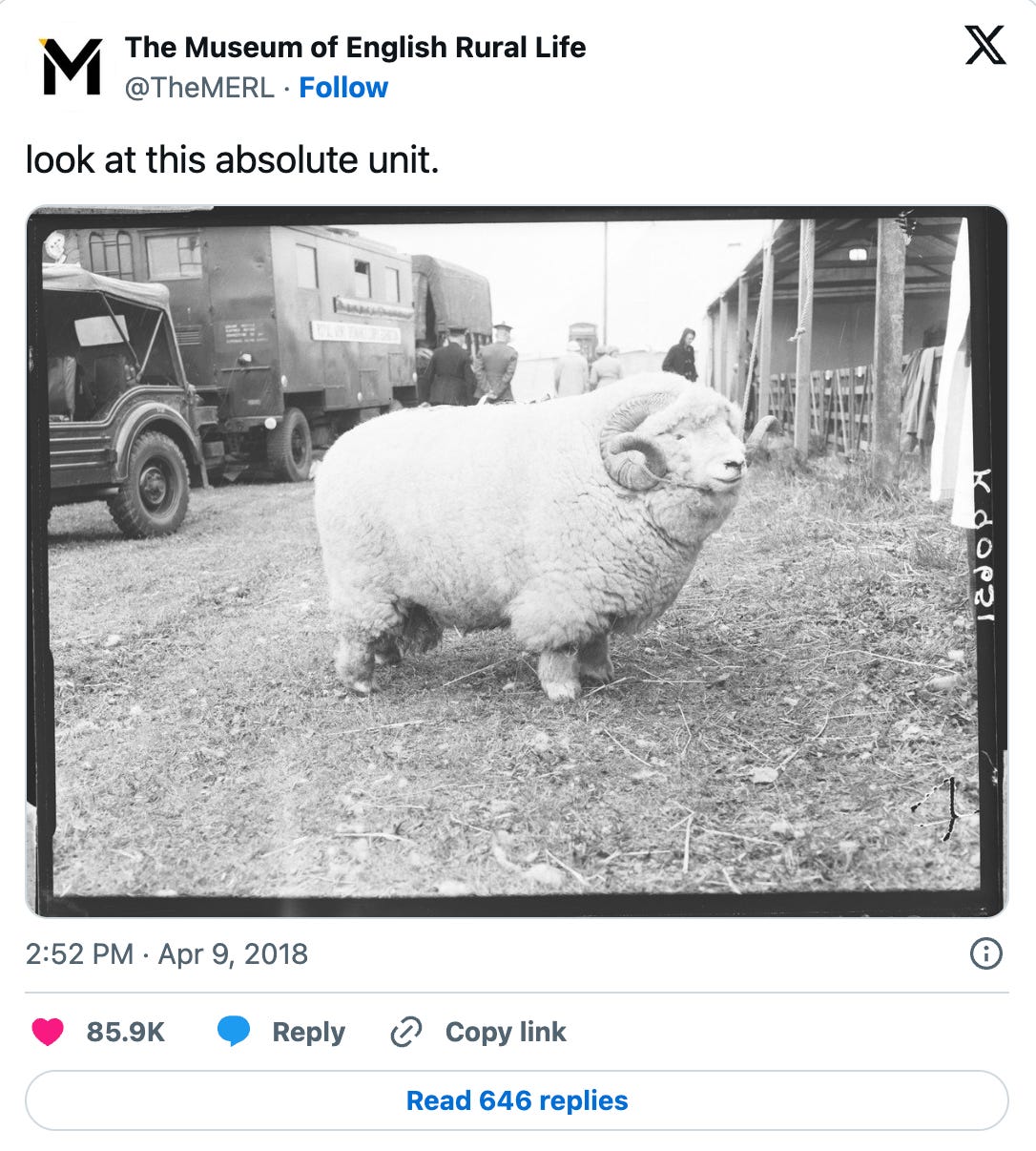
In 2018, a member of our curatorial team Adam Koszary tweeted a photo from our collection (of a very large sheep) with a trending meme caption: ‘look at this absolute unit’. The tweet blew up instantly and our world changed forever.
Within a day, the absolute unit tweet had 63,000 likes, 19,000 retweets, and increased our followers by 7,000.
The tweet did an extraordinary job of expressing part of our collection in a trending framework that people already understood (a humorous interest in unusually large things). It was very simple to understand and this was key to its effectiveness. Five words and a picture. Not overcomplicated. A perfect joke.
It’s worth highlighting that Adam wasn’t the Museum’s social media manager. Instead, at the time, social media was shared between different staff members. Looking back, it’s an example of an employee generating amazing content based on their expertise, long before employee generated content gained traction on LinkedIn. Adam built an incredible career in content from this tweet onwards, later working at Tesla, the Royal Academy of Arts, and now as a freelance consultant.
The tweet was significant because it was a risk. It’s easy to think of museums as places that only operate in long, formal, and fact-checked interpretation. Yet that isn’t how good social media (or humour) operates; the shorter and snappier the better, and editorial processes have to be fast. The half-life of a meme is very small. This post was an act of impulse, a moment of a museum communicating on Twitter like any regular person. A lot of this approach was inspired by the savvy work of American brands, like Wendy’s and Denny’s, or Gregg’s in the UK, who were pioneering humour in this space.
How did you build on that sudden popularity?
The Museum made a few bold changes after the absolute unit’s success.
For one, Adam was given the reins to the social media accounts and encouraged to take more risks in the content we produced.
This led to multiple other viral moments - like the story of discovering a doodle of a chicken in trousers, and a thread about rescuing a bat from the Museum library. These threads combined humour, memes, and Museum stories to make the museum a protagonist of not just Museum Twitter but of Twitter itself. We wanted to be like the popular meme accounts, and that means dressing down from the garb of a formal institution.
The Museum also soon hired its first dedicated content creator: me! Adam left the Museum in 2019, and by that point The MERL’s digital success had grown enough to warrant a dedicated member of staff.
Unlike Adam, I wasn’t from a museum background; I was working in content at an agency (and before then, I did a Creative Writing poetry MA with Simon Armitage!) and I wanted any job where I could write. I loved what the American brands were doing and was a huge fan of The MERL before joining. The opportunity to do it at a museum was a life-changing one.
Have you changed the tone at all? How did you maintain consistency across multiple platforms?
Yes. I think the tone has naturally changed as our accounts have grown; there are some risks we wouldn’t take now because we have more to lose. But we still embrace a huge amount of creativity and flair. Fundamentally, our measure of success hasn’t changed: we understand that being successful online requires acting and thinking like a well-intended user. For all intents and purposes you’re not a museum any more; you’re another voice in the weird world of the Internet, saying your piece in the ways you think will give the world the most. We also have a huge belief in experimentation and the importance of impulse, which is a massive part of creative work. If you take a risk and it doesn’t pay off, great; you haven’t lost much in those 280 characters. Next!
You also have a podcast now! When did you launch the podcast and did you deliberately keep the tone in keeping with the rest of your online presence?
Matching the tone of our social media was a very deliberate decision. We recognised there was a gap in our content strategy, where we excelled at short-form posts (280 characters at a time) but we lacked a space for longer pieces. Podcasting seemed like the best opportunity for exploring our stories at greater depths, and doing so in a personable and engaging way that built on the strengths of our socials. We wanted to be fun and interesting but with more wordcount, and the podcast has allowed that.
Do you have any tips for readers about developing and maintaining an effective tone of voice on social media?
I think you have to be able to read and respect the rooms that you’re in online. Think about it: you’re sending messages to people who are leading busy, complex, and stressful lives. You’re also appearing in a newsfeed that’s a mess of the world’s making and displaying alongside everything difficult that’s happening right now. How do you want your content to appear within that? What can you say that adds value and is generous?
This can be more challenging when you’re asking people for something or trying to make a sale. So if you’re doing that, think about what you can give to get goodwill?
I think people are too quick to analyse social media in terms of statistics and pure numbers as if it’s a maths game. Sure, that’s easier to report. But I think good social media lives and dies by intangibles like feeling, and you have to figure out how to approximate metrics for that.
What role do you think tone of voice plays in shaping and building institutional reputation?
I think your tone of a voice reflects a fundamental position of how your organisation interfaces with the world. You’re the sum of your posts, and the way you speak and present collects into a giant signal of how you want to be received and who you want to reach.
The challenge for institutions is doing this in a way that’s coherent. If you’re an institution that’s welcoming or alternative online, do you match that in person or in your deeds? That coherence is really important and users are smart. I think the ‘be gone brand’ memes that you often see in response to brands being edgy are often attacking this disconnect.
I get asked a lot whether I think every institution should be funny. You know it’s not a good question when the answer is obviously no. But I do think every institution should remember that they’re effectively in a dialogue with their users (even if the users aren’t speaking back). How do you want to be remembered from that conversation? That’s your tone of voice strategy right there.
Follow Joe on LinkedIn and Instagram, and subscribe to the Strat Comms Surgery for more monthly comms insights.
What a fantastic interview: informative, insightful, interesting and funny. Great piece. Valuable.